Does the Position of a Fig Cutting Affect Rooting?
Yes. And there are also alternative ways to successfully root fig cuttings.Advice about propagating figs from hardwood cuttings follows mostly the same basic method: take a dormant cutting, place it upright in a free-draining growing medium, keep it warm and moist, and wait for roots to develop.That method works very well. Figs are among the easier fruit trees to propagate from cuttings.
Is that it?
Researchers and professional nurseries suggest that successful fig propagation may involve more than simply sticking a cutting into a pot. This might come as a surprise to some, but the position and orientation of a cutting can influence how it responds, and this is a field we are focusing our research on at The Fig Shop.In particular, cuttings placed vertically, at an angle, or horizontally can behave differently.
This raises an interesting question:
What is the most effective way to produce a strong, well-rooted young fig tree?
Why Orientation Matters
A fig cutting is not simply a piece of dead wood waiting to grow. Even after removal from the parent tree, it retains its natural polarity.The end that originally pointed towards the roots remains the basal end, while the end that pointed towards the growing tip remains the upper end. This polarity continues to influence where roots and shoots develop.
With a conventional vertical cutting, the lower part is buried in the rooting medium while one or more buds remain above the surface. Roots generally develop from the buried portion, while new shoots emerge from buds higher up.This creates a simple, predictable young tree.
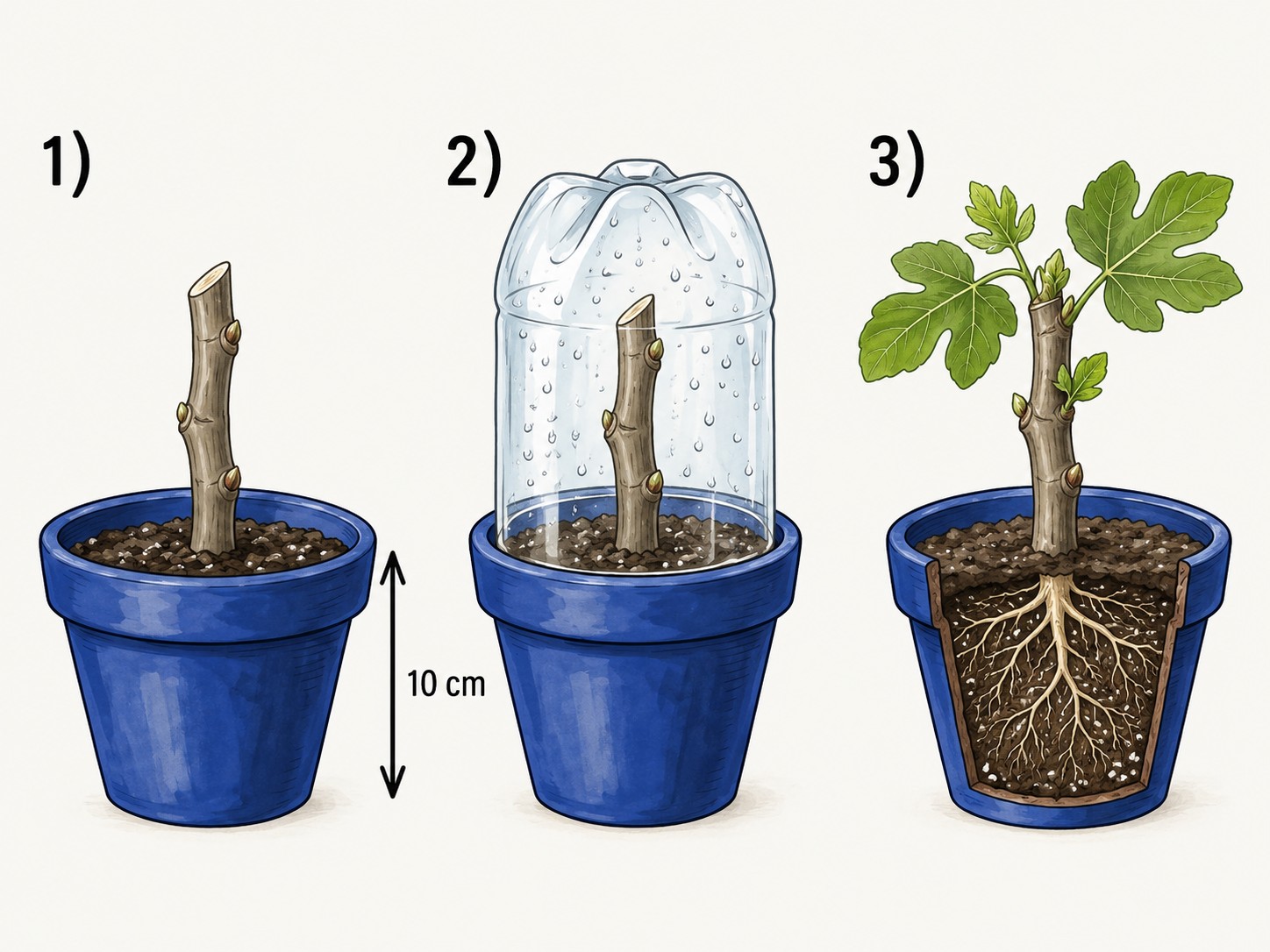
But when you plant a cutting at an angle, or even lay it horizontally beneath a shallow covering of growing medium, more of the stem comes into close contact with moist, aerated material.
That can potentially create several rooting points along the stem.
Horizontal fig cuttings
Figs are particularly well suited to this kind of experiment because they readily produce adventitious roots from buried stems.A horizontal cutting may therefore behave rather differently from a vertical one.
Instead of producing most of its roots from the lower portion, a horizontally buried cutting may form roots around several nodes along its length. More than one bud may also begin to grow.
This could produce a broader and potentially stronger root system.It may also offer an interesting method of multiplying rarer varieties, because one sufficiently long horizontal cutting can sometimes produce several rooted growing points.
However, this is not necessarily an advantage in every situation.For nursery production, a single upright shoot with a compact root system is often easier to pot, train and sell. A horizontal cutting that produces several shoots may therefore need additional pruning or division later.
For that reason, the traditional vertical method remains extremely useful.
The important point is that horizontal propagation should not automatically be dismissed simply because vertical planting has traditionally been the standard method.

Vertical, angled or horizontal?
At The Fig Shop, we are increasingly interested in comparing the three approaches.
Vertical cuttings
This remains the simplest and most reliable method.Advantages include:·
~ easy planting
~ easy labelling
~ natural upright growth
~ compact root systems
~ straightforward potting-on
~ efficient use of nursery space.
For most general propagation, vertical planting remains an excellent choice.
Cuttings planted at about 45 degrees
Some growers prefer to place hardwood cuttings at an angle.
This increases the amount of stem close to the surface and may encourage root formation along a greater length of the cutting.It can also make it easier to bury several nodes without placing the base excessively deep in the pot.
However, angled planting does not automatically guarantee better results than vertical planting. Other factors — particularly temperature, moisture, oxygen and the quality of the cutting — are likely to be at least as important.
Horizontal cuttings
Horizontal propagation is potentially the most interesting method.
Lay the cutting flat in a shallow tray or pot and cover it with only a few centimetres of rooting medium.
Several nodes are then close to the surface, where moisture and oxygen are well balanced.
The result can be extensive rooting along the stem and sometimes several shoots.This method deserves further investigation, particularly for varieties that are valuable, scarce or slower to multiply.
Cutting length matters too
Another important consideration is the size of the cutting itself.
Very short fig cuttings can root successfully, but they contain relatively small reserves of stored carbohydrates and moisture.
A longer cutting has more stored energy available to support callus formation, root development and the first flush of shoot growth.
For normal propagation, we generally favour reasonably substantial dormant cuttings rather than very short pieces.
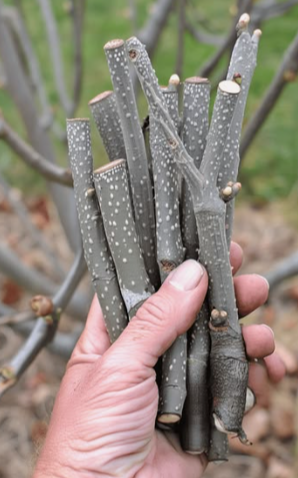
A useful practical range is often around: 20–30 cm long with several healthy nodes.Longer cuttings can also be successful, but for ordinary nursery propagation there is usually little advantage in making every cutting excessively long.
The aim is to find a balance between efficient use of valuable wood and producing a cutting with sufficient reserves to establish strongly.
Thicker cuttings can be surprisingly good
Some assume fig cuttings should always be pencil-thick. Pencil-thick material is certainly convenient and roots readily, but figs are much less restricted in this respect than many other fruit crops.
Thicker wood can root very successfully. In fact, thicker cuttings have several possible advantages:
~ greater stored carbohydrate reserves
~ greater stored moisture
~ more resistance to drying out
~ more energy available during early root formation
~ the ability to produce a stronger young plant relatively quickly.
This means that healthy fig wood that is somewhat thicker than the conventional pencil-sized cutting should not automatically be discarded. For many varieties, it can make excellent propagation material.

Older wood may also be useful
Another common assumption is that only the youngest one-year growth should be used.
Again, figs are more flexible than this. Well-ripened one-year-old wood remains excellent material and is normally the easiest to handle. However, healthy older wood can also root successfully.
Older wood is often thicker and contains substantial stored reserves.Recent propagation research on figs has shown that cutting age, diameter and position on the original shoot can influence rooting performance. In some circumstances, more mature wood has performed extremely well.
This is particularly interesting for growers because pruning often produces substantial pieces of older fig wood that might otherwise be discarded.
Provided the wood is:
~ healthy
~ fully dormant
~ free from disease
~ not badly damaged
~ not excessively old or decayed
it may still be valuable propagation material.
At The Fig Shop, we therefore do not automatically reject a cutting simply because it is thicker or older than the conventional ideal.

More important than orientation: air and moisture
Whatever orientation is used, one principle remains fundamental. A fig cutting needs moisture, but it also needs oxygen.
One of the most common causes of failed propagation is keeping the rooting medium too wet. A waterlogged mixture contains too little air and can cause the lower part of the cutting to rot before roots have had time to form.
The ideal propagation medium should therefore remain lightly moist while also being very free draining.Materials such as perlite, coco coir and light propagation compost can all be useful.
A good rule is that the medium should feel damp but should not release water when squeezed firmly. For dormant fig cuttings, slightly too dry is often less dangerous than constantly saturated.
Bottom heat can make a major difference
Temperature strongly influences rooting. During winter and very early spring, a cutting may remain dormant simply because the rooting medium is too cold. At The Fig Shop, our rooted cuttings are eventually moved into a polytunnel where bottom heat can be used from around February. This creates a particularly useful situation.
The rooting medium can be kept warm while the upper part of the cutting remains relatively cool. That encourages the cutting to begin producing roots before excessive top growth develops.
For figs, a root-zone temperature around 22–24°C is a useful starting point.The aim is not to create tropical conditions around the entire plant.It is to provide gentle warmth around the part of the cutting where roots need to develop.
Why too much early shoot growth can be a problem
One of the deceptive things about fig propagation is that a cutting can produce leaves before it has developed a proper root system. The cutting contains stored carbohydrates and moisture, so buds may begin growing using reserves already present in the wood.
A cutting covered in leaves is therefore not necessarily a rooted cutting.This is particularly important when propagating indoors. Very warm air temperatures may stimulate the buds rapidly while the lower part of the cutting is still struggling to produce roots.
The ideal situation is almost the opposite: warm rooting medium and relatively cool air.
That allows roots to develop first.Once a good root system has formed, stronger shoot growth can safely follow.
What about rooting cuttings in plastic bags?
A popular method seen increasingly online involves wrapping fig cuttings in damp kitchen paper, placing them inside a sealed plastic bag and keeping them somewhere warm and dark. This method can work extremely well.
The combination of warmth and very high humidity encourages callus and root initials to develop. However, it also has disadvantages.Cuttings kept this way can develop mould, roots may grow into the paper, and newly formed roots can be damaged when the cutting is eventually transferred into a pot.
For that reason, we see this technique as particularly useful for pre-callusing rather than necessarily allowing a complete root system to develop inside the bag. Once a cutting develops obvious callus or small white root initials, it can be transferred carefully into a free-draining propagation mix.
This can be particularly useful for scarce or valuable varieties where the grower wants to monitor individual cuttings closely.For larger-scale nursery propagation, planting directly into a suitable medium is generally simpler.
Our approach at The Fig Shop
We continue to refine our propagation methods rather than assuming that the traditional method is necessarily the only one worth using. Over the coming propagation season we intend to compare
~ vertically planted cuttings
~ cuttings planted at approximately 45 degrees
~ horizontally planted cuttings
~ different cutting lengths
~ different thicknesses of wood
~ younger and somewhat older dormant wood.
The most useful measure is not simply whether a cutting produces roots. For us, the real question is:
Which method produces the largest number of strong, healthy, saleable young fig trees?
A method that roots 95 per cent of cuttings is not necessarily better than one that roots slightly fewer if the latter produces stronger plants, larger root systems or more usable plants from the same amount of propagation material.
The simple lesson
Fig trees are remarkably willing plants when it comes to propagation. The traditional pencil-thick vertical cutting remains an excellent and dependable method, but it should not be regarded as the only successful approach. Longer cuttings often carry greater reserves.
Thicker cuttings can root extremely well.Older wood should not automatically be discarded.And horizontal propagation may prove to be a particularly useful technique where a grower wants to encourage extensive rooting or obtain more than one plant from valuable propagation material.
As with so much in fig growing, careful observation is invaluable.Sometimes the plants themselves show us that there is more than one way to do things.